
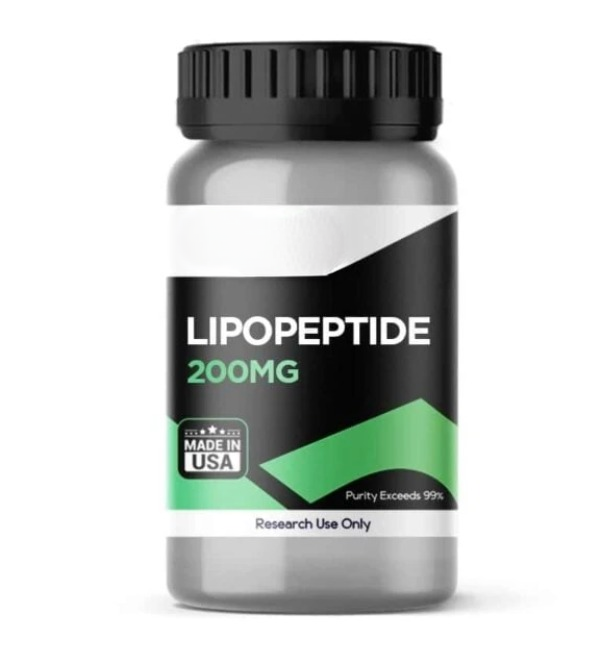
Lipopeptide (200mg)
$210.00
Size: 200mg
Contents: GHK-Cu
Form: Lyophilized powder
Purity: >99%
SKU: P-LIPOPEPTIDE-200
Lipopeptide for Laboratory Research
Lipopeptide represents a versatile class of amphiphilic molecules that combine a peptide moiety with one or more lipid chains, making it a valuable tool across multiple laboratory disciplines. Researchers value this compound for its ability to interact with membranes, modulate immune signaling pathways in experimental systems, and serve as a model for studying self-assembly and biosurfactant behavior. DirectPepLabs supplies high-purity material intended exclusively for in-vitro and non-clinical research applications.
The structural hallmark of a lipopeptide is the covalent attachment of a fatty-acid or lipid chain to a short peptide sequence. This dual nature creates molecules that are simultaneously water-soluble and membrane-active. In laboratory settings the resulting amphiphilicity enables studies of micelle formation, vesicle disruption, and receptor engagement. Natural examples produced by Bacillus and Pseudomonas species have long been examined for their surface-active properties, while synthetic analogues allow precise control over chain length, amino-acid composition, and stereochemistry.
Literature describes several families of these compounds. Surfactin, iturin, and fengycin families illustrate the diversity of cyclic structures that can be generated by non-ribosomal peptide synthetases. Linear versions such as the well-characterized Pam2CSK4 and Pam3CSK4 constructs are routinely employed as Toll-like receptor ligands in immunological assays. Researchers also investigate hybrid molecules in which the lipid portion is varied systematically to map structure–activity relationships. All such work remains confined to controlled experimental environments.
One frequently cited research benefit is the capacity of selected lipopeptides to engage pattern-recognition receptors on cultured immune cells. Published studies demonstrate that certain synthetic constructs activate downstream signaling cascades in a concentration-dependent manner under defined culture conditions. These observations support the use of the molecules as tool compounds when investigators wish to probe innate immune pathways without introducing live pathogens. Parallel work has examined membrane insertion and pore-forming tendencies in artificial lipid bilayers, providing biophysical data that inform model-membrane experiments.
Another area of active investigation involves the self-assembly properties of these amphiphiles. Depending on concentration, pH, and ionic strength, lipopeptides can form micelles, vesicles, fibers, or other supramolecular structures. Laboratory groups exploit this behavior to create defined nanoscale assemblies for delivery-vehicle prototyping or for studying protein–lipid interactions. The same physicochemical traits underlie the biosurfactant activity documented in environmental and agricultural microbiology literature, where the compounds reduce surface tension and emulsify hydrophobic substrates under sterile culture conditions.
Antimicrobial research has also drawn upon members of the class. Certain cyclic lipopeptide antibiotics, including commercially available agents such as daptomycin, have been characterized extensively for their effects on Gram-positive bacterial membranes in laboratory assays. Parallel academic efforts explore newly isolated or synthetically modified variants against panels of bacterial and fungal strains. All such experiments remain strictly in-vitro or non-clinical; no therapeutic claims are associated with research-grade material.
Pricing for research-grade lipopeptide reflects several variables: sequence length, lipid-chain complexity, required purity level (typically ≥95 % by HPLC), and batch size. Small research quantities suitable for pilot experiments are priced to allow multiple groups to evaluate the material without large capital outlay. Larger quantities benefit from economies of scale, reducing the per-milligram cost. DirectPepLabs maintains transparent pricing that accounts for synthesis complexity while remaining competitive with other specialized peptide suppliers. Researchers are encouraged to request current quotations that reflect the precise specifications needed for their protocols.
Proper storage and handling preserve the integrity of the compound. Most lyophilized lipopeptides remain stable for extended periods when stored desiccated at –20 °C or lower, protected from light and repeated freeze–thaw cycles. Once reconstituted in an appropriate solvent—commonly sterile water, dilute acetic acid, or a mild organic co-solvent—the solution should be aliquoted and stored according to the stability data supplied with each batch. Laboratory personnel should follow standard peptide-handling practices: minimize exposure to moisture during weighing, use clean glassware or plasticware free of contaminants, and document lot numbers for experimental reproducibility.
Selecting a reliable supplier requires attention to several practical criteria. Certificate-of-analysis documentation that includes HPLC purity, mass-spectrometric confirmation, and residual-solvent data is essential. Consistency across batches supports longitudinal studies. Turnaround time from order to shipment affects project timelines, especially when the material is required for time-sensitive assays. Customer support that can answer technical questions about solubility or recommended reconstitution methods adds further value. DirectPepLabs meets these expectations by providing detailed analytical documentation with every shipment and by maintaining inventory of frequently requested research compounds.
Delivery preparation begins with clear communication of the required quantity, purity specification, and preferred shipping conditions. Research peptides are typically shipped under controlled temperature conditions when necessary, using insulated packaging and cold packs or dry ice for longer transit times. Laboratories should designate a receiving contact who can place the material into appropriate storage immediately upon arrival. Tracking information allows teams to anticipate delivery and schedule experiments accordingly. For international shipments, customs documentation is prepared to facilitate smooth clearance of research materials.
Long-term and bulk purchasing strategies help laboratories maintain continuity of supply. Establishing a standing order or scheduled delivery of a validated lot reduces the risk of stock-outs during multi-month projects. Bulk quantities can be subdivided into smaller, labeled aliquots under controlled conditions, limiting the number of freeze–thaw events experienced by any single portion. Some research groups maintain a small working stock at –20 °C while keeping the bulk reserve at –80 °C. Coordinating with the supplier on projected annual usage allows production planning that further stabilizes pricing and availability.
DirectPepLabs distinguishes itself through a focused commitment to research-grade peptides and related compounds. The company prioritizes analytical rigor, transparent documentation, and responsive technical support. Material is produced and quality-controlled with laboratory end-users in mind, ensuring that each batch meets the purity and identity standards required for reproducible experiments. Competitive pricing, reliable shipping logistics, and a growing catalog of research tools position the supplier as a practical partner for academic, government, and industrial laboratories engaged in peptide-related investigations.
Researchers evaluating lipopeptide for new projects often begin with small-scale purchases to confirm solubility and behavior under their specific assay conditions. Once performance is verified, scaling to larger quantities becomes straightforward. The amphiphilic character of the molecule can sometimes present formulation challenges; early consultation with the supplier’s technical team can identify suitable solvents or co-solvents that maintain stability while remaining compatible with downstream experimental systems.
In addition to the core research applications already outlined, literature continues to explore novel uses. Groups studying vaccine-adjuvant design examine the ability of certain constructs to enhance antigen presentation in cell-culture models. Others investigate the compounds as components of synthetic biology toolkits or as templates for designing new membrane-active agents. Each of these avenues remains firmly within the realm of basic and applied laboratory research.
Quality control remains non-negotiable. Every batch supplied by DirectPepLabs is accompanied by a certificate of analysis that lists purity by reverse-phase HPLC, molecular-weight confirmation by mass spectrometry, and, where applicable, residual trifluoroacetic-acid or solvent content. Researchers can request additional analytical data when their protocols demand higher stringency. This level of documentation supports both internal quality systems and external publication requirements that increasingly expect detailed characterization of research reagents.
Handling precautions mirror those used for other research peptides. Personnel should wear appropriate personal protective equipment, work in a clean environment, and avoid generating aerosols during weighing or reconstitution. Spill procedures follow institutional chemical-hygiene plans. Because the material is intended solely for laboratory use, it is never to be employed in any clinical, veterinary, or consumer context.
When planning multi-year programs, laboratories benefit from early engagement with the supplier. Sharing projected consumption volumes allows the production team to schedule synthesis runs that align with experimental milestones. This collaborative approach reduces lead times and helps lock in favorable pricing for larger commitments. DirectPepLabs welcomes such planning discussions and can provide guidance on packaging formats that best suit long-term storage needs.
The physicochemical diversity within the lipopeptide class means that not every member behaves identically. Chain length, degree of saturation, peptide sequence, and cyclization status all influence solubility, critical micelle concentration, and biological activity in experimental systems. Researchers are therefore advised to consult the specific product data sheet for the exact material they intend to use rather than relying on generalized assumptions drawn from related compounds.
Literature reviews published in recent years continue to highlight the expanding toolkit of synthetic and semi-synthetic lipopeptides available to the research community. Improved solid-phase synthesis methods and refined purification protocols have increased both the purity and the structural variety of materials that can be obtained commercially. These advances translate directly into more reproducible experimental outcomes and broader experimental design options.
For laboratories that require custom sequences or specialized lipid attachments, DirectPepLabs can discuss custom-synthesis options. Custom work proceeds under clear project timelines and includes the same analytical documentation provided for catalog items. Early communication of sequence, desired purity, and quantity allows accurate quotation and scheduling.
In summary, lipopeptide offers researchers a flexible platform for investigating membrane interactions, immune signaling, self-assembly, and related phenomena under controlled laboratory conditions. High-purity material, thorough analytical support, and practical purchasing options enable efficient experimental progress. DirectPepLabs stands ready to supply the research community with reliable product and responsive service.
FAQ
What purity levels are available? Standard research-grade material is supplied at ≥95 % purity by HPLC; higher specifications can be discussed for specialized applications.
How should the lyophilized product be stored? Store desiccated at –20 °C or colder, protected from light and moisture, until ready for reconstitution.
Is documentation provided with each shipment? Yes. A certificate of analysis detailing purity, identity, and relevant residual content accompanies every order.
Can bulk quantities be ordered? Yes. Volume pricing is available; contact the team for quotations based on projected needs.
Researchers seeking a dependable source of lipopeptide for ongoing laboratory investigations will find DirectPepLabs equipped to support both small pilot studies and larger-scale programs. The combination of analytical transparency, competitive pricing, and practical logistics makes the supplier a logical choice for laboratories that require consistent research reagents. Place an inquiry or order today to secure high-quality material for your next set of experiments.



Reviews
There are no reviews yet.