
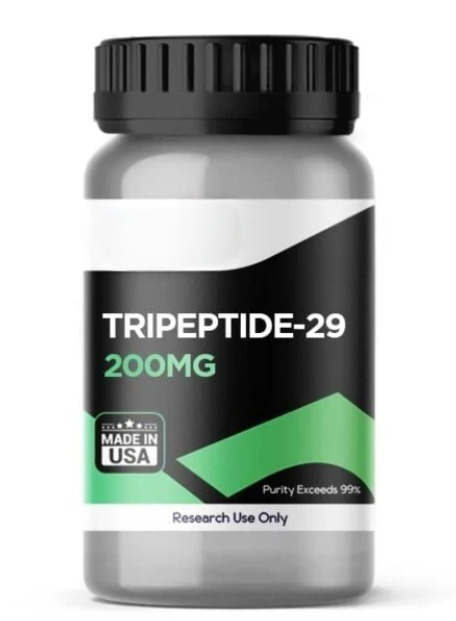
Tripeptide-29 (200mg)
$173.00
Size: 200mg
Contents: Tripeptide-29
Form: Lyophilized powder
Purity: >99%
SKU: P-Tripeptide-29
Tripeptide-29
Researchers seeking tripeptide-29 for laboratory studies of collagen structure and extracellular-matrix signaling will find a high-purity lyophilized form suited to controlled experimental work. Tripeptide-29 is the synthetic tripeptide Gly-Pro-Hyp (glycyl-prolyl-hydroxyproline). It corresponds to the most abundant repeating motif found in fibrillar collagens and is examined in research settings as a minimal collagen-mimetic fragment.
Literature frames the molecule as a useful probe for fibroblast responses, collagen-precursor synthesis, and matrix-remodeling pathways. Studies remain confined to in-vitro systems, tissue models, and non-clinical preparations. The material supplied by DirectPepLabs is intended strictly for such laboratory applications.
The peptide is typically supplied as a lyophilized solid. This presentation supports straightforward handling, extended stability under proper storage, and compatibility with standard analytical methods including HPLC and mass spectrometry. Certificates of analysis accompany each batch so investigators can confirm identity and purity before use.
Overview of the Research Peptide
Tripeptide-29 belongs to the broad class of short collagen-derived sequences often grouped under the term tripeptides. The native collagen molecule is built from repeating Gly-X-Y units in which X is frequently proline and Y is frequently hydroxyproline. The synthetic tripeptide reproduces this core motif with high chemical purity.
Because of its small molecular weight (approximately 285 Da), the compound dissolves readily in aqueous or mildly acidic solvents and is convenient for quantitative work. Researchers studying matrikine signaling, fibroblast activation, or the contribution of hydroxyproline to triple-helix stability frequently select this sequence as a defined reference standard.
In laboratory practice the lyophilized powder is reconstituted under sterile conditions, aliquoted, and stored according to protocol requirements. The availability of research-grade material with verified batch data allows consistent comparison across experiments and between laboratories.
Benefits Framed by Research Literature
Published investigations position tripeptide-29 primarily as a structural and signaling probe. The Gly-Pro-Hyp sequence is recognized by certain collagen receptors and can influence downstream pathways related to matrix synthesis in cell-culture models. Early work established that hydroxyproline-containing tripeptides contribute to the thermodynamic stability of collagen-like triple helices.
Later studies examined the ability of the free tripeptide to modulate fibroblast activity and collagen-precursor production under controlled conditions. Comparative experiments place the molecule alongside other short collagen fragments and synthetic tripeptides used to dissect receptor recognition and anabolic responses. No therapeutic claims are made for the research material; the focus remains on mechanistic insight and assay development.
Consistency of purity is valued because even modest variations in peptide integrity can alter binding or signaling read-outs. Independent HPLC and mass-spectrometric confirmation supports reproducibility. The lyophilized format further reduces degradation risk during transit and storage, preserving the structural features required for reliable data.
Additional literature has explored the behavior of Gly-Pro-Hyp in different buffer systems, its interaction with common laboratory plastics, and its recovery after freeze-thaw cycles. These practical observations help experimentalists design robust protocols that minimize artefactual loss of activity.
Pricing Considerations for Laboratory Procurement
Pricing for research peptides reflects synthesis complexity, purification rigor, and analytical verification. Tripeptide-29, as a short three-residue sequence containing hydroxyproline, is produced by solid-phase or solution-phase methods followed by high-resolution purification. Competitive suppliers list milligram-to-gram quantities at prices that scale with documented purity and supporting certificates.
DirectPepLabs structures pricing to favor laboratory continuity: transparent per-milligram costs, volume discounts, and inclusion of batch-specific certificates without extra fees. Investigators comparing sources should weigh unit price against the availability of third-party test data, shipping reliability, and residual-solvent information. Offerings that omit analytical support can introduce hidden costs through failed experiments or the need for independent verification.
For long-running projects, securing material from a consistent production campaign often yields better effective pricing and experimental continuity than repeated small purchases from varying sources. Laboratories with established protocols can request quotes for larger quantities once preliminary data confirm utility in their specific assays.
Storage and Handling Guidelines
Lyophilized tripeptide-29 is best stored at –20 °C or colder in a desiccated environment protected from light. Under these conditions the peptide maintains integrity for extended periods when the vial remains sealed. Brief ambient excursions during shipping are generally tolerated by properly packaged material; prompt transfer to cold storage upon receipt is recommended.
Reconstitution should employ sterile technique and solvents appropriate to the planned matrix—commonly sterile water or dilute acetic acid. Once in solution the material is more susceptible to hydrolysis. Refrigerated storage of reconstituted aliquots limits short-term degradation; longer-term preservation is best achieved by freezing single-use aliquots to avoid repeated freeze-thaw cycles.
Vials should be handled with clean, powder-free gloves and opened only in a controlled environment. After each use the stopper can be wiped and the vial returned promptly to cold storage. These practices preserve both chemical purity and the validity of subsequent analytical or bioassay results.
Laboratories that work routinely with short collagen tripeptides often develop standardized receiving and logging procedures. Recording lot number, receipt date, and visual appearance creates a traceable record that supports quality systems and troubleshooting.
Supplier Evaluation and Buying Tips
Selecting a source for research peptides requires attention to documentation, manufacturing transparency, and logistical reliability. Key criteria include batch-specific certificates of analysis from independent laboratories, clear purity thresholds (commonly ≥98 % or ≥99 % by HPLC), and mass-spectrometric confirmation of identity. Suppliers that publish residual-solvent data provide additional confidence for sensitive work.
Domestic U.S. fulfillment often reduces transit time and simplifies tracking. Responsive technical support—especially the ability to answer questions about solubility, recommended storage, or lot history—further differentiates reliable partners.
Avoid sources that lack verifiable analytical data or that extend claims beyond laboratory research use. For critical studies, ordering a small initial quantity for independent verification before committing to larger volumes remains a prudent practice. Researchers who require full analytical backing prioritize suppliers that make certificates readily accessible.
Delivery Preparation and Receipt
Before ordering, confirm that laboratory receiving procedures accommodate temperature-sensitive materials. Upon arrival, inspect packaging for damage or temperature-indicator activation. Transfer the sealed vial immediately to the designated freezer and log the lot number, receipt date, and storage location. Retain the certificate of analysis with laboratory records.
If reconstitution is planned soon after arrival, prepare sterile diluent, calibrated pipettes, and labeled aliquot tubes in advance. Working in a clean environment reduces the risk of contamination. Document reconstitution date, solvent, final concentration, and any appearance notes so subsequent users of the same stock can verify continuity.
Long-Term and Bulk Procurement Strategies
Laboratories conducting multi-year matrix or fibroblast research benefit from bulk or scheduled procurement. Larger single-lot purchases reduce inter-batch variability and often lower the effective cost per milligram. Suppliers experienced with research accounts can accommodate staggered deliveries that align with experimental timelines.
When evaluating bulk options, request confirmation that the quoted material will derive from a single production campaign and that certificates will cover the entire quantity. Establishing a preferred-supplier relationship facilitates rapid response when additional material is required mid-study.
Why DirectPepLabs
DirectPepLabs focuses exclusively on research-grade peptides intended for laboratory use. Each batch of tripeptide-29 undergoes independent HPLC and mass-spectrometric verification, with certificates of analysis supplied as standard. Domestic production and fulfillment support rapid turnaround and reduce transit-related variables.
Transparent pricing, responsive technical support, and consistent documentation allow investigators to concentrate on experimental design. The company maintains clear labeling that the materials are not for human or veterinary consumption and are sold solely for in-vitro and laboratory research purposes. This positioning aligns with institutional purchasing policies.
Frequently Asked Questions
What is the sequence of tripeptide-29? The sequence is Gly-Pro-Hyp (glycyl-prolyl-hydroxyproline).
Is the material supplied as a lyophilized powder? Yes. Research-grade tripeptide-29 is typically provided as a lyophilized solid.
What purity level should I expect? Each batch is verified by independent HPLC and mass spectrometry, with certificates documenting purity suitable for research applications.
How should I store the lyophilized powder? Store sealed vials at –20 °C or colder, protected from light and moisture.
Can I order bulk quantities? Volume pricing and multi-vial options are available. Contact support for quotes aligned with your experimental timeline.
Closing Invitation
Laboratories ready to work with tripeptide-29 for controlled studies of collagen-mimetic signaling or extracellular-matrix pathways can place orders directly through the DirectPepLabs catalog. Review available vial sizes, confirm current lot documentation, and proceed with confidence that the material meets rigorous analytical standards.
For volume inquiries or technical questions regarding solubility and handling, contact the support team. Whether the need is for single-vial quantities or larger lots of research-grade material, the catalog is structured to support ongoing experimental programs involving short collagen tripeptides and related sequences.



Reviews
There are no reviews yet.